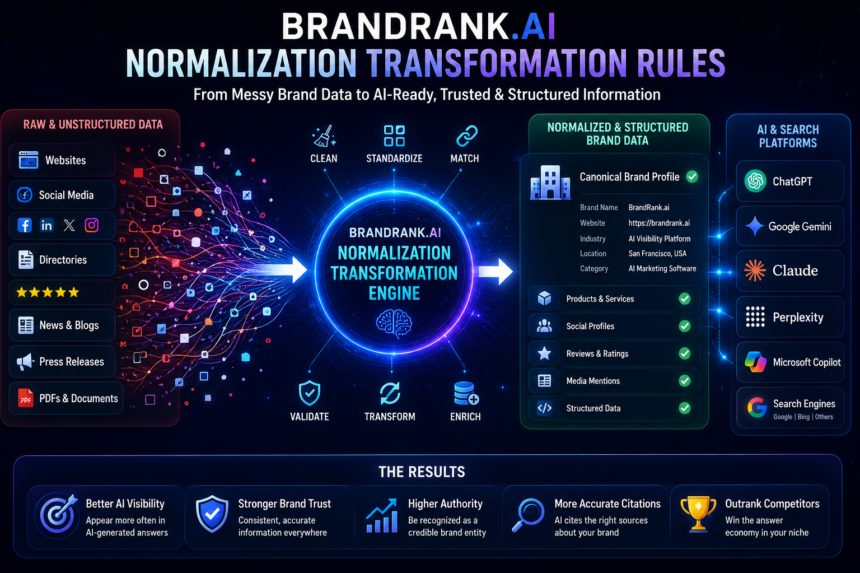
The way people discover brands online has changed dramatically. Instead of typing keywords into Google and browsing multiple websites, millions of users now ask AI assistants like ChatGPT, Gemini, Claude, Microsoft Copilot, and Perplexity for direct answers. These AI systems don’t simply rank websites—they analyze information from across the web and decide which brands deserve to be mentioned.
This shift has created a new challenge for businesses. Even companies with excellent SEO may struggle to appear in AI-generated answers if their brand information is inconsistent across different platforms.
That’s where BrandRank.ai Normalization Transformation Rules become important.
Although the phrase has gained popularity recently, many people still don’t fully understand what it actually means. Some assume it’s a secret algorithm, while others believe it’s only relevant for developers or data engineers. In reality, it’s a practical framework that helps organize scattered brand information into a consistent, AI-friendly format.
In this guide, you’ll learn what BrandRank.ai Normalization Transformation Rules are, how normalization differs from transformation, why consistent brand data matters for AI visibility, and how businesses can implement these practices to strengthen their presence across modern AI search engines.
Whether you’re an SEO professional, digital marketer, business owner, or content strategist, this guide will help you understand one of the most important concepts shaping AI-powered search in 2026.
What Are BrandRank.ai Normalization Transformation Rules?
BrandRank.ai Normalization Transformation Rules refer to a collection of processes used to clean, standardize, organize, and transform brand information into a format that AI systems can understand more accurately.
Think about how a company appears online.
Its website may use one version of the company name.
LinkedIn may display another.
Business directories might still show an older company name.
Review websites could list outdated addresses.
News articles may reference previous branding.
While humans instantly recognize these as the same business, AI models don’t always make that connection.
Normalization transformation rules solve this problem by ensuring every reference points back to one consistent brand identity.
Instead of treating multiple variations as different companies, AI systems can confidently recognize them as a single entity.
Understanding the Two Core Concepts
Although the terms are often used together, normalization and transformation perform different jobs.
What is Normalization?
Normalization focuses on consistency.
Its goal is to ensure that the same information always follows one standard format.
Examples include:
- Converting “BrandRank AI,” “BrandRank.AI,” and “Brand Rank AI” into one official brand name.
- Standardizing address formats.
- Using identical capitalization across all platforms.
- Removing duplicate records.
- Updating outdated product names.
Simply put, normalization makes data consistent.
What is Transformation?
Transformation takes that cleaned information and converts it into a format another system can easily process.
For example, an AI-generated paragraph might become structured information like:
| Raw AI Response | Structured Output |
| BrandRank.AI helps companies monitor AI visibility. | Brand Mention = Yes |
| Sentiment = Positive | |
| Category = AI Visibility | |
| Citation = No |
Transformation doesn’t change the meaning—it simply restructures information.
Why Are These Rules Becoming So Important?
Traditional SEO focused on ranking web pages.
Modern AI search focuses on understanding entities.
Instead of asking:
“Which webpage should rank first?”
AI systems ask:
“Which company is most trustworthy for answering this question?”
To answer that question, AI models analyze signals from multiple sources, including:
- Official websites
- News publications
- Review platforms
- Business directories
- Social profiles
- Forums
- Research articles
- Structured data
- Knowledge graphs
If these sources contain conflicting information, AI confidence decreases.
Lower confidence often means lower visibility in AI-generated responses.
How AI Understands Brands
Imagine a coffee company called BlueBean Coffee.
Across the internet, AI finds these variations:
- BlueBean
- Blue Bean Coffee
- BlueBean Coffee Ltd.
- BlueBean Roasters
- BlueBeanCafe.com
A human immediately realizes they’re connected.
An AI system may interpret them as five different businesses unless sufficient evidence links them together.
Normalization creates one official identity.
Transformation organizes that identity into structured records AI systems can interpret.
Together, they dramatically improve brand clarity.
Why Consistent Brand Data Matters
Brand consistency isn’t only about design or marketing anymore.
It’s now a technical advantage.
When AI systems repeatedly encounter identical information across trusted sources, they become more confident that the information is accurate.
Higher confidence often leads to:
- Better entity recognition
- More accurate AI citations
- Improved Answer Engine Optimization (AEO)
- Stronger Generative Engine Optimization (GEO)
- Better brand authority
- Reduced misinformation
- Cleaner analytics
- More reliable reporting
Companies with fragmented data often experience the opposite.
Their information becomes diluted across multiple identities.
Real-Life Example
Suppose a software company appears online like this:
Website:
CloudPilot
LinkedIn:
Cloud Pilot
Crunchbase:
CloudPilot Inc.
Old Blog Posts:
CloudPilot Software
Google Business Profile:
Cloud Pilot Technologies
Without normalization, AI could interpret these as several different organizations.
After normalization, every variation maps back to one canonical entity:
CloudPilot
Now AI systems have much greater confidence when mentioning the company in generated answers.
Common Areas That Require Normalization
Most organizations need to normalize information across several categories.
1. Brand Name
Maintain one official company name everywhere.
Example:
❌ Tech Vision
❌ TechVision Inc.
❌ Tech Vision AI
✅ TechVision
2. Website URLs
Different URL versions should resolve to one canonical version.
Example:
- https://example.com
- http://example.com
- https://www.example.com
Should all point toward one preferred URL.
3. Product Names
Every product should use one official naming convention.
Avoid switching between:
- Pro Analytics
- ProAnalytics
- Analytics Pro
unless they’re actually different products.
4. Locations
Addresses should remain consistent across:
- Google Business Profile
- Apple Maps
- Yelp
- Company website
- Business directories
5. Social Profiles
Every official profile should clearly identify the same company using:
- identical branding
- matching descriptions
- consistent logos
- official website links
6. Historical Company Names
If your business has rebranded, AI still encounters historical information.
Good normalization connects:
Old Brand → New Brand
instead of treating them as unrelated entities.
The Relationship Between SEO and AI Visibility
SEO hasn’t disappeared.
It has evolved.
Traditional SEO helps search engines understand webpages.
Normalization helps AI systems understand brands.
The two work together.
| Traditional SEO | AI Visibility |
| Keywords | Entities |
| Rankings | Mentions |
| Backlinks | Brand Consistency |
| Search Results | AI Answers |
| Webpages | Knowledge Graphs |
Businesses succeeding in AI search usually invest in both.
Key Takeaways
BrandRank.ai Normalization Transformation Rules are not a mysterious algorithm or hidden ranking factor. They represent a practical approach to organizing brand information so AI systems can accurately recognize, understand, and reference a business across multiple sources.
As AI-powered search becomes more influential, maintaining consistent brand data is no longer optional. It plays a crucial role in how confidently AI models identify your company, connect related information, and decide whether to mention your brand in generated answers.
How BrandRank.ai Normalization Transformation Rules Work
Understanding the theory is one thing, but seeing how the process works in practice makes it much easier to understand. Although every AI visibility platform has its own technology, the overall workflow follows a similar pattern.
The goal isn’t simply to clean data—it’s to transform scattered information into one reliable source of truth that AI systems can recognize with confidence.
The Complete Normalization Workflow
A successful normalization process usually follows several connected stages instead of one single action.
Step 1: Collect Data from Every Available Source
The first stage is gathering all publicly available information about a brand.
This information may come from:
- Official website
- Google Business Profile
- X (Twitter)
- Product pages
- Press releases
- Online directories
- News websites
- Review platforms
- Partner websites
- Knowledge Graphs
At this point, the data is often messy.
One company may appear under ten different names.
Addresses may use different formats.
Products may have multiple spellings.
Older branding may still exist online.
The purpose of this stage is not to fix anything—it is simply to collect everything first.
Step 2: Clean Individual Data Fields
Once the information has been collected, every field is examined separately.
Common cleaning tasks include:
- Removing duplicate spaces
- Correcting capitalization
- Standardizing punctuation
- Removing unnecessary symbols
- Fixing inconsistent abbreviations
- Standardizing country names
- Formatting phone numbers
- Converting dates into one standard format
This stage creates consistency before deeper analysis begins.
Step 3: Resolve Brand Identity (Entity Resolution)
Entity Resolution is one of the most important parts of the entire process.
Its job is simple:
Decide whether different pieces of information belong to the same real-world company.
Consider this example.
The internet contains these names:
- Bright Vision
- BrightVision
- Bright Vision Ltd.
- BrightVision Inc.
- Bright Vision Software
AI doesn’t automatically know they’re connected.
Entity Resolution checks additional signals such as:
- Website domain
- Logo
- Business description
- Industry
- Social profiles
- Address
- Product names
- Contact information
If enough evidence matches, all variations are linked to one official entity.
This greatly improves AI confidence.
Step 4: Create One Canonical Brand Record
After Entity Resolution is complete, one official version becomes the master record.
For example:
| Field | Canonical Value |
| Brand Name | BrightVision |
| Website | https://brightvision.com |
| Industry | AI Software |
| Headquarters | New York |
| Official Profile | |
| Primary Category | AI Analytics Platform |
Every future variation points back to this record.
Step 5: Transform Raw Information into Structured Data
Normalization creates consistency.
Transformation creates structure.
Imagine AI reads this paragraph:
BrightVision develops AI software that helps businesses analyze customer feedback.
Transformation converts that paragraph into structured information.
| Field | Value |
| Brand Mention | Yes |
| Industry | AI Software |
| Topic | Customer Analytics |
| Sentiment | Positive |
| Citation | No |
| Product Category | Analytics Platform |
Structured information is much easier to analyze than long paragraphs.
Step 6: Validate Everything
Before data enters reports or AI dashboards, validation checks whether something looks incorrect.
Examples include:
- Invalid URLs
- Duplicate companies
- Missing fields
- Incorrect phone numbers
- Broken schema markup
- Wrong country codes
- Incorrect categories
Validation improves accuracy before information reaches decision makers.
10 Common BrandRank.ai Normalization Transformation Rules
Every organization may implement different rules, but these are the most common.
1. Brand Name Normalization
This ensures every variation points toward one official brand.
Example:
❌ Alpha Tech
❌ AlphaTech
❌ Alpha-Tech
✅ AlphaTech
2. Website URL Normalization
Websites often appear in several versions.
Example:
http://company.com
https://company.com
https://www.company.com
company.com
These should resolve to one canonical URL.
3. Product Name Normalization
Products frequently appear under different names.
Example:
Old:
AI Writer Pro
AIWriter
AI Writer
New Standard:
AI Writer Pro
4. Location Normalization
Addresses should use one standard format everywhere.
Instead of:
New York
NY
NYC
New York City
Choose one approved format based on business needs.
5. Social Profile Normalization
Official profiles should all connect back to the same company.
Each profile should use:
- Same logo
- Same company description
- Same website
- Same naming convention
6. Category Normalization
Businesses often describe themselves differently.
Example:
- Marketing Platform
- Marketing Software
- Digital Marketing Tool
- Marketing Automation Solution
Choose one primary category.
7. Historical Name Mapping
Companies rebrand frequently.
Example:
Old Name:
Future Systems
New Name:
FutureCloud
Historical names shouldn’t disappear.
Instead, they should connect back to the current entity.
8. Duplicate Record Removal
Duplicate records produce inaccurate reports.
A good normalization engine identifies duplicates using:
- Website
- Address
- Phone Number
- Company Registration
- Domain
9. Date Standardization
Different countries use different date formats.
Example:
07/06/2026
06-07-2026
July 6, 2026
All should convert into one consistent format for reporting.
10. Language Normalization
Global brands often have multiple language versions.
Example:
Google España
Google France
Google Deutschland
These should remain connected while still identifying regional differences.
Why Entity SEO Depends on Normalization
Search engines increasingly understand brands as entities, not just websites.
An entity is anything with a unique identity.
Examples include:
- Company
- Product
- Person
- Organization
- Location
When AI confidently recognizes an entity, it becomes easier to:
- Connect related information
- Understand relationships
- Detect authority
- Recommend trusted brands
- Reduce misinformation
Poor normalization weakens entity confidence.
Strong normalization strengthens it.
Schema Markup and AI Understanding
Schema markup helps machines understand webpages.
Instead of guessing what information means, AI receives explicit labels.
Example:
- Organization
- Product
- Person
- FAQ
- Review
- Article
Good schema supports normalization because it reinforces the same canonical information already found across the web.
However, schema should always match the visible content on your website. Adding inaccurate or misleading structured data can reduce trust instead of improving it.
Measuring AI Visibility After Normalization
Once your brand data becomes consistent, you can begin tracking meaningful performance indicators.
Some useful metrics include:
| Metric | What It Measures |
| Brand Mention Rate | How often your brand appears in AI answers |
| Citation Rate | How frequently AI references trusted sources about your brand |
| Share of AI Voice | Your visibility compared with competitors |
| Entity Accuracy | Whether AI identifies your company correctly |
| Prompt Coverage | Percentage of prompts where your brand appears |
| Sentiment Score | Positive, neutral, or negative perception |
| Source Diversity | Number of unique trusted sources mentioning your brand |
| Claim Accuracy | Percentage of correct information in AI responses |
Rather than focusing on a single AI response, monitor trends over weeks and months. Consistent improvements in these metrics often indicate stronger brand recognition across AI-powered platforms.
Common Mistakes Businesses Make
Even companies investing in AI visibility often make avoidable mistakes.
Here are some of the most common:
- Assuming normalization is a one-time project instead of an ongoing process.
- Using different brand names across departments.
- Forgetting to update old press releases after a rebrand.
- Creating duplicate Google Business listings.
- Ignoring outdated directory information.
- Mixing product names with company names.
- Adding schema markup that doesn’t match visible page content.
- Treating every online mention as an official citation.
- Failing to monitor AI-generated answers over time.
Avoiding these issues can significantly improve the consistency and reliability of your brand’s online presence.
Best Practices for Using BrandRank.ai Normalization Transformation Rules
Understanding the concept is only the first step. The real value comes from applying these practices consistently across your business. Whether you manage a small website or a global brand, following a structured approach can improve how AI systems recognize and represent your company.
Below are the most effective practices for building AI-ready brand data.
Create a Single Source of Truth
Every business should maintain one official record that defines its brand identity.
Your master record should include:
- Official company name
- Legal business name
- Website URL
- Logo
- Brand description
- Product names
- Contact information
- Headquarters address
- Social media profiles
- Primary business category
Whenever new content is published, compare it against this master record to ensure consistency.
2. Keep Your Website Updated
Your website is usually the primary source AI systems trust.
Review important pages regularly, including:
- Homepage
- About Us
- Contact Page
- Product Pages
- Service Pages
- Author Profiles
- FAQ Section
- Privacy Policy
Make sure every page uses the same brand name, product names, and contact information.
3. Audit Third-Party Listings
Many businesses focus only on their website while forgetting about external platforms.
Check your information on:
- Google Business Profile
- Crunchbase
- Yelp
- Trustpilot
- Industry directories
- Local business listings
Correct outdated information wherever possible.
4. Use Accurate Structured Data
Schema markup helps search engines and AI models understand your website more clearly.
Useful schema types include:
- Organization
- Product
- Article
- FAQPage
- Person
- BreadcrumbList
- LocalBusiness
Always ensure your structured data matches the visible content on the page.
5. Monitor AI Responses Regularly
AI-generated answers change over time.
Test prompts such as:
- What is your company?
- Best software for…
- Top companies in…
- Is your brand trustworthy?
- Alternatives to your product
Track:
- Brand mentions
- Citations
- Accuracy
- Sentiment
- Competitors
- Missing information
This helps identify new opportunities and errors before they affect customers.
AI Visibility Checklist
Use this checklist to evaluate your brand.
Brand Identity
✔ Official brand name is consistent
✔ Product names are standardized
✔ Old company names are documented
✔ Logo remains identical everywhere
✔ Company description is consistent
Website
✔ HTTPS enabled
✔ Canonical URLs configured
✔ Updated contact information
✔ Consistent branding
✔ Correct internal linking
✔ Fast loading pages
Structured Data
✔ Organization Schema
✔ Product Schema
✔ FAQ Schema
✔ Author Schema
✔ Valid structured data
✔ Correct sameAs links
AI Visibility
✔ Brand appears in AI answers
✔ Citations are accurate
✔ Competitors monitored
✔ Prompt testing performed monthly
✔ AI misinformation tracked
The Future of Brand Normalization
AI search is still evolving.
Future AI models will likely become even better at understanding:
- Brand relationships
- Products
- Authors
- Organizations
- Locations
- Customer reviews
- Business reputation
However, they will also expect cleaner and more structured information.
Businesses that begin improving their data today will have a significant advantage over competitors that continue relying only on traditional SEO strategies.
Normalization is gradually becoming an essential part of digital marketing rather than a technical afterthought.
Final Thoughts
The rise of AI-powered search has changed how brands are discovered online. Today, success isn’t determined solely by keyword rankings or backlinks—it’s increasingly influenced by how consistently your brand is represented across the web.
BrandRank.ai Normalization Transformation Rules provide a practical framework for organizing scattered information into a clear, unified identity that AI systems can recognize and trust. By standardizing brand names, product details, website information, locations, structured data, and third-party profiles, businesses reduce confusion and strengthen their digital presence.
It’s important to remember that normalization is not a shortcut to instant rankings or guaranteed AI mentions. Instead, it lays the foundation for better data quality, stronger entity recognition, and more reliable AI visibility over time.
As AI assistants continue to shape how people research products, compare services, and make purchasing decisions, maintaining consistent and accurate brand information will become an increasingly valuable competitive advantage. Businesses that invest in clean, trustworthy, and well-structured data today will be better positioned to earn visibility, credibility, and customer trust in the AI-driven search landscape of tomorrow.
FAQs
What are BrandRank.ai Normalization Transformation Rules?
They are a set of practices that organize inconsistent brand information into a consistent, structured format that AI systems can understand more accurately.
Are these official BrandRank.ai rules?
No. The phrase is commonly used as an educational framework to explain brand data normalization and AI visibility practices. Public information from BrandRank.ai focuses on AI visibility, prompt tracking, and brand monitoring rather than publishing a detailed proprietary rulebook.
Does normalization improve Google rankings?
Not directly.
Normalization improves data quality, entity recognition, and AI visibility. Better rankings still depend on high-quality content, backlinks, technical SEO, and user experience.
Is normalization only useful for large companies?
No.
Small businesses often benefit even more because they usually have fewer locations, products, and historical records to manage, making consistency easier to maintain.
How often should businesses review their brand data?
A quarterly audit is a good starting point.
Businesses that frequently update products, pricing, or locations should review their data monthly.
Can schema markup guarantee AI citations?
No.
Schema markup provides clearer information to search engines and AI systems, but it does not guarantee citations, rankings, or recommendations.
What’s the difference between SEO and AI Visibility?
SEO focuses on helping webpages rank in search engines.
AI Visibility focuses on helping AI systems recognize, understand, and accurately mention your brand when generating answers.
Both strategies complement each other rather than compete.
Why is entity consistency important?
When AI sees the same company represented consistently across trusted sources, it becomes more confident that all references describe the same business. Higher confidence can improve the accuracy of AI-generated responses.