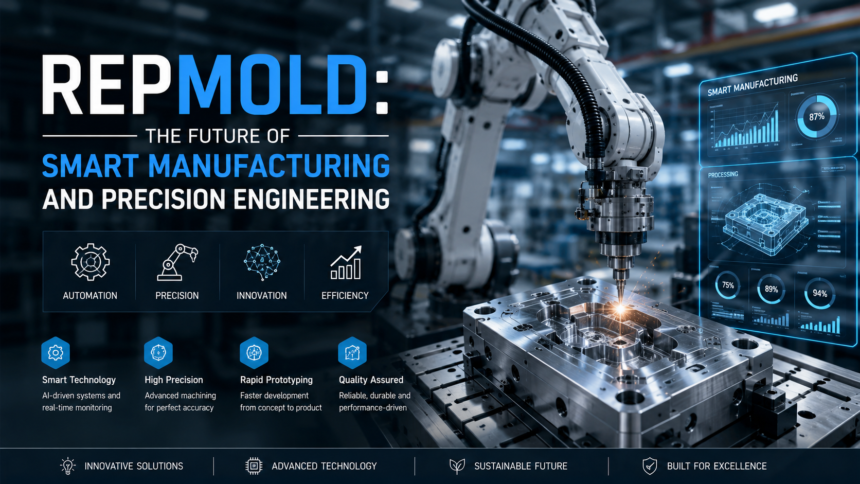
Modern manufacturing is evolving rapidly as businesses look for faster, more accurate, and cost-effective ways to design and produce products. Technologies such as automation, digital engineering, artificial intelligence, and additive manufacturing are reshaping how factories operate. Within this transformation, RepMold has emerged as a term associated with modern replication molding, rapid tooling, and precision manufacturing workflows.
Although the term RepMold is increasingly discussed across technology websites and blogs, it is important to understand that there is no universally accepted industry standard or officially recognized manufacturing technology called “RepMold.” Instead, the term is commonly used to describe advanced manufacturing approaches that combine 3D printing, CAD (Computer-Aided Design), digital modeling, CNC machining, and rapid prototyping to create high-quality molds more efficiently.
This guide explains what RepMold means, how it works, its benefits, applications, limitations, and why it represents the future of smart manufacturing.
What Is RepMold?
RepMold is a modern manufacturing concept that focuses on producing accurate molds through digital engineering and rapid manufacturing technologies. Instead of relying entirely on traditional machining methods that can take several weeks, manufacturers use digital design software and advanced fabrication techniques to shorten development cycles.
In practical terms, RepMold combines multiple manufacturing technologies rather than representing a single machine or patented process. Engineers design a component digitally, validate it using simulation software, create prototypes through additive manufacturing or CNC machining, and finally produce molds suitable for testing or production.
Because there is currently no official international definition of RepMold, the term should be understood as an umbrella concept describing intelligent mold manufacturing rather than a specific commercial technology.
How RepMold Works
The RepMold workflow generally follows several connected stages that improve both speed and accuracy.
Digital Product Design
The process begins with CAD software, where engineers create detailed 3D models. Every dimension, surface, tolerance, and assembly feature is designed digitally before physical manufacturing starts.
Digital modeling allows design teams to identify errors early, reducing expensive modifications later.
Engineering Simulation
Before manufacturing begins, software simulations evaluate stress, heat flow, material behavior, and manufacturability.
Simulation minimizes production risks and helps engineers optimize mold performance.
Rapid Prototyping
Once the design is approved, prototypes are produced using technologies such as:
- Industrial 3D printing
- CNC machining
- Resin printing
- High-speed milling
Rapid prototyping allows companies to test products before investing in expensive production tooling.
Mold Manufacturing
After successful testing, manufacturers create production molds using appropriate materials based on product requirements.
These molds may be used for:
- Plastic injection molding
- Silicone molding
- Vacuum casting
- Compression molding
- Prototype production
Testing and Production
The completed mold undergoes dimensional inspection, quality testing, and trial production before entering full-scale manufacturing.
Key Technologies Used in RepMold
RepMold relies on several advanced manufacturing technologies working together.
Computer-Aided Design (CAD)
CAD software creates accurate digital models that improve precision while reducing manual design errors.
Computer-Aided Manufacturing (CAM)
CAM software converts digital designs into machining instructions for CNC equipment.
3D Printing
Additive manufacturing enables engineers to build complex geometries quickly while reducing material waste.
CNC Precision Machining
CNC machines manufacture metal molds with extremely tight tolerances required for industrial production.
Industrial Automation
Robotic systems automate repetitive manufacturing processes while improving consistency and productivity.
Artificial Intelligence
AI assists with quality inspection, predictive maintenance, production planning, and manufacturing optimization.
Major Benefits of RepMold
Faster Product Development
Traditional tooling often requires several weeks or even months.
RepMold significantly reduces development time by combining digital engineering with rapid manufacturing technologies.
Higher Precision
Modern software and automated machining produce highly accurate molds that improve final product quality.
Lower Manufacturing Costs
Digital validation reduces expensive design revisions while minimizing wasted materials and labor costs.
Improved Product Quality
Computer simulations identify potential problems before production begins, leading to more reliable products.
Better Design Flexibility
Complex internal structures and intricate geometries become easier to manufacture using modern digital workflows.
Sustainable Manufacturing
Many manufacturers use recyclable materials, optimized machining paths, and additive manufacturing techniques that reduce waste and energy consumption.
Industries Using RepMold
RepMold principles are useful across numerous industries.
Automotive Industry
Manufacturers develop prototype parts, dashboards, interior components, brackets, and testing equipment more efficiently.
Aerospace Engineering
Aircraft manufacturers require lightweight, highly accurate components with strict quality standards.
Digital manufacturing helps meet these demanding requirements.
Medical Device Manufacturing
Healthcare companies produce:
- Surgical guides
- Medical prototypes
- Dental molds
- Custom healthcare components
Precision is especially important in medical manufacturing.
Consumer Electronics
Electronics manufacturers create housings, connectors, wearable devices, and testing components using advanced mold technologies.
Industrial Equipment
Factories manufacture custom machine components, replacement parts, and production tooling more quickly.
Research and Product Development
Universities and engineering companies frequently use rapid tooling during research and product testing.
RepMold vs Traditional Manufacturing
| Feature | RepMold Approach | Traditional Manufacturing |
| Design Process | Digital | Manual + Digital |
| Prototype Speed | Fast | Slow |
| Accuracy | Very High | High |
| Material Waste | Lower | Higher |
| Design Changes | Easy | Expensive |
| Production Efficiency | High | Moderate |
| Automation | Extensive | Limited |
| Development Cost | Lower for prototypes | Higher |
Challenges of RepMold
Although RepMold offers many benefits, adopting it can require a significant upfront investment. Businesses often need advanced design software, precision machinery, and employee training, which may be costly for small or growing manufacturers.
Another challenge is that RepMold is not suitable for every application. Some complex or high-volume production projects still rely on traditional mold-making methods because they provide better performance for specific materials and manufacturing requirements.
Success with RepMold also depends on skilled engineers and efficient digital workflows. Companies must ensure proper planning, regular equipment maintenance, and continuous staff training to achieve consistent quality and maximize the value of modern manufacturing technologies.
Why RepMold Represents the Future of Manufacturing
Manufacturing is becoming increasingly data-driven.
Factories are integrating:
- Artificial Intelligence
- Industrial Internet of Things (IIoT)
- Robotics
- Cloud Manufacturing
- Machine Learning
- Digital Twins
- Smart Sensors
- Predictive Maintenance
RepMold aligns closely with these Industry 4.0 technologies by emphasizing intelligent production, digital design, rapid prototyping, and precision engineering.
As manufacturing continues to evolve, businesses adopting digital-first production strategies are likely to achieve higher efficiency, lower costs, and improved product quality.
Best Practices for Implementing RepMold
To get the best results from RepMold, businesses should begin by using reliable CAD and CAM software and creating an efficient digital manufacturing workflow. Accurate digital designs reduce errors, improve precision, and speed up the production process.
Employee training is equally important. Engineers and machine operators should understand modern manufacturing technologies, digital modeling, and quality control to ensure smooth production and consistent results.
Manufacturers should also test designs through simulation before creating physical molds. Using high-quality materials, maintaining equipment regularly, and monitoring production performance help improve efficiency, reduce downtime, and ensure long-term manufacturing success.
Conclusion
RepMold represents the growing shift toward smart manufacturing, precision engineering, and digital production workflows. While the name itself is not an officially standardized manufacturing technology, it is widely used to describe modern methods that combine CAD, rapid prototyping, CNC machining, automation, and advanced molding techniques.
For businesses focused on innovation, shorter development cycles, and higher manufacturing accuracy, adopting these digital manufacturing practices can provide a significant competitive advantage. As Industry 4.0 continues to expand, the principles associated with RepMold are expected to play an increasingly important role in the future of product design and precision engineering.
FAQs
Is RepMold an official manufacturing technology?
No. There is currently no universally recognized industrial standard or officially defined manufacturing technology called RepMold. The term is commonly used online to describe modern replication molding, rapid tooling, and digital manufacturing approaches.
What technologies are commonly associated with RepMold?
RepMold typically involves CAD design, CAM software, CNC machining, industrial automation, rapid prototyping, and 3D printing.
Which industries benefit the most?
Automotive, aerospace, healthcare, consumer electronics, industrial manufacturing, research laboratories, and engineering companies all benefit from advanced digital manufacturing workflows.
Does RepMold replace traditional mold manufacturing?
Not entirely. Traditional tooling remains essential for many high-volume production applications, while digital manufacturing accelerates design, prototyping, and low-volume production.
Is RepMold suitable for small businesses?
Yes. Small manufacturers can adopt parts of the workflow, such as CAD design, simulation, or outsourced 3D printing, without investing in a complete industrial production system.